

Many people arrive at Sanctuary Clinics having already tried to get help somewhere else. They remember the forms, the same questions asked twice, and the feeling that no one ever saw the whole picture. The crisis got managed, but the person behind it never quite got understood.
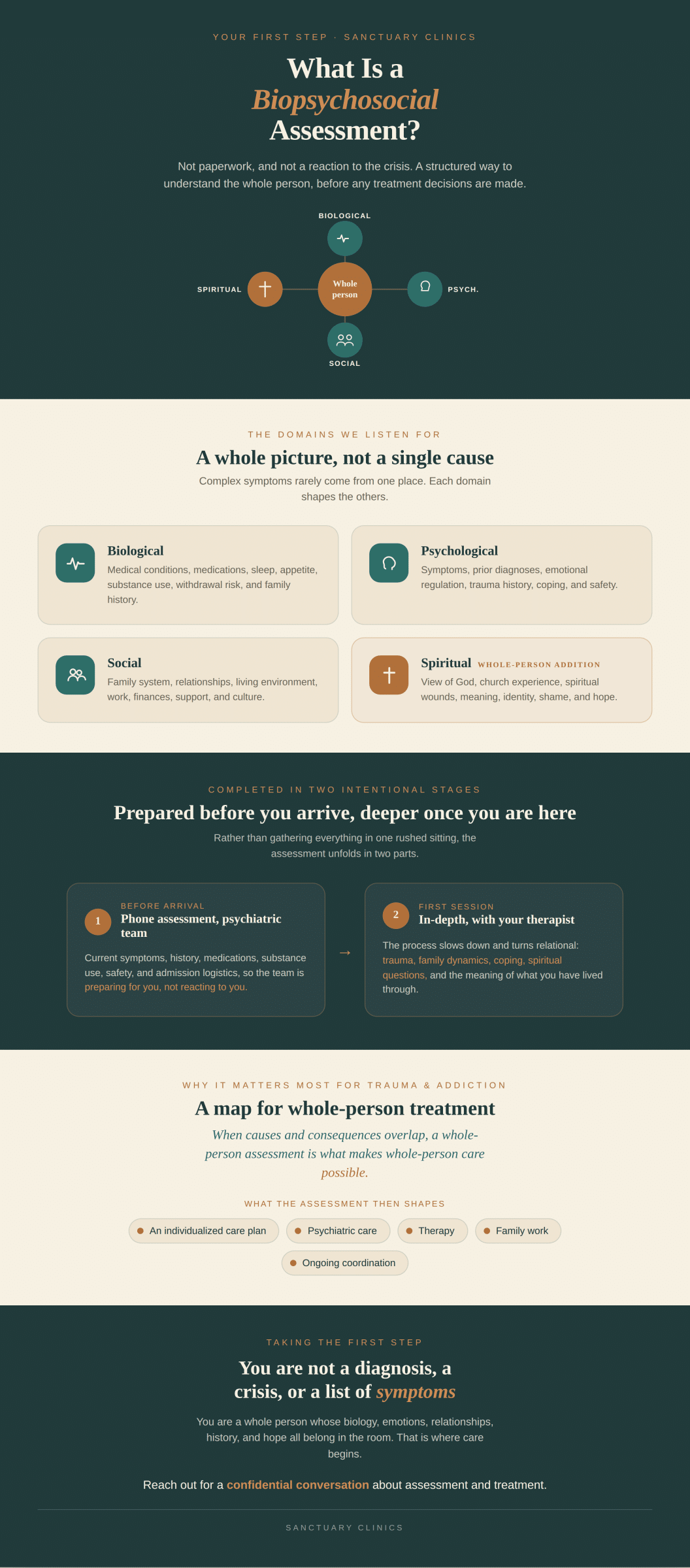
We start differently. One of the first things we do is a biopsychosocial assessment, a structured clinical process that helps us understand how biological, psychological, and social factors have shaped what someone is living through right now. It is not paperwork. It is how we begin treatment with a real picture of the person instead of a reaction to the crisis.
This matters because complex symptoms rarely come from one cause. Depression, trauma, substance use, psychosis, anxiety, and relational instability are usually shaped by overlapping medical, emotional, social, and environmental factors. A comprehensive assessment gives us a far better starting point for accurate diagnosis, thoughtful planning, and care built around the individual.
Why does a biopsychosocial assessment matter?
A biopsychosocial assessment is usually completed during intake to support diagnosis, guide treatment planning, and document medical necessity. It also surfaces the risk factors, protective factors, coping strategies, and practical barriers that decide whether recovery holds. That is most true when mental health and substance use overlap, where important details are easy to miss early.
People rarely arrive with just one issue. One person is carrying trauma and alcohol use. Another is dealing with depression, broken sleep, and a history of cannabis-related psychiatric symptoms. Someone else holds strong faith alongside deep shame, family conflict, or spiritual confusion. A narrow intake misses how these things feed one another. The assessment is built to bring them into view, so care can start from understanding rather than assumption.
Where does biopsychosocial fit in your journey at Sanctuary Clinics?
We complete the biopsychosocial in two intentional stages rather than all at once. The goal is simple: be clinically prepared before someone arrives, then go deeper once they are on campus and beginning therapy. This mirrors the broader clinical distinction between early intake information gathering and the fuller biopsychosocial used for complete treatment planning.
Get Help Today.
We are here to help you through every aspect of recovery.
Let us call you to learn more about our treatment options.
We are here to help you through every aspect of recovery. Let us call you to learn more about our treatment options.
Stage one: pre-admission phone assessment with our psychiatric team
Before arrival, a member of our psychiatric team completes a shorter version of the biopsychosocial over the phone. It focuses on current symptoms, psychiatric and medical history, medications, substance use, safety concerns, and the practical issues that affect admission.
This call is not just administrative. It lets us think ahead about medication protocols, immediate stabilization, and any monitoring a client may need, and it even helps us make better roommate decisions for shared spaces. We would rather be ready for someone before they arrive than sort through essential questions afterward. When our psychiatric team already understands the major biological and safety concerns, a client walks in to a team preparing for them rather than reacting to them.
Stage two: in-depth biopsychosocial with your primary therapist
The second part happens with the primary therapist in the first individual session, and this is where the process slows down and turns relational. A comprehensive biopsychosocial goes past surface information to connect symptoms with history, relationships, strengths, risks, and goals.
Because the phone assessment already handled the urgent psychiatric and logistical questions, the therapist does not have to spend that first session gathering stabilization basics. That time goes instead to trauma, family dynamics, emotional patterns, coping, spiritual questions, and the meaning of what a client has lived through. The psychiatric team prepares for arrival; the therapist deepens the story once a client is present and settled. Together that is a more thoughtful beginning than any one-time intake.
The three domains of the biopsychosocial assessment
Biological factors. The biological portion looks at health factors that affect mood, behavior, cognition, and safety: medical conditions, medications, allergies, surgeries, hospitalizations, sleep, appetite, substance use, and family medical or psychiatric history. Physical health, medication side effects, withdrawal risk, and chronic illness all shape how symptoms appear and what will actually help. For some clients this means anticipating detox concerns; for others, reviewing medication history, sleep disruption, or chronic pain. The body matters in recovery.
Psychological factors. The psychological domain explores how a person thinks, feels, copes, and makes sense of life: current symptoms, prior diagnoses, past treatment, emotional regulation, trauma history, and safety concerns including self-harm and suicidality. Because many conditions look alike on the surface, a careful history helps us tell them apart and choose interventions that genuinely fit. This is usually the most personal part of the story, and we listen for the patterns in context rather than rushing to a label.
Social factors. The social domain looks at the world around the person: family system, relationships, living environment, work or school pressure, finances, legal concerns, support, and cultural context. Symptoms never emerge in a vacuum. Conflict at home, isolation, unstable housing, or lack of support can deepen suffering and complicate recovery. Looking honestly at these realities makes treatment planning realistic, naming both the risks and the resources, and it often explains why someone has stayed stuck even when they sincerely wanted help.
Integrating the spiritual story
A traditional biopsychosocial centers on the biological, psychological, and social, but many whole-person frameworks also include spiritual concerns, meaning, and values. In a Christian treatment setting that matters, because a person’s view of God, their church experience, their spiritual wounds, and their hopes for restoration shape how they interpret suffering and pursue healing.
So the story we listen for is not limited to symptoms. It includes meaning, belonging, shame, identity, and hope. For some clients faith is a deep source of resilience. For others, spiritual confusion or church-related pain is part of the clinical picture. Either way it belongs in the conversation if the care is going to be honest and whole.
Get Help Today.
We are here to help you through every aspect of recovery.
Let us call you to learn more about our treatment options.
We are here to help you through every aspect of recovery. Let us call you to learn more about our treatment options.
What happens after the assessment
The value of the assessment is in how we use what we learn. Comprehensive assessments support recommendations, identify the right services, and shape individualized care plans. In a multidisciplinary setting, that information guides psychiatric care, therapy, recovery support, family work, and ongoing coordination. It helps us clarify what needs immediate attention and what longer-range work should begin, organizing care around the actual person rather than a generic protocol.
Why this matters for trauma and addiction
This approach matters most in trauma and addiction, where causes and consequences overlap. Federal guidance on co-occurring disorders stresses assessing mental health, substance use, medical issues, and related social problems together as part of full treatment planning. Trauma touches the body, beliefs, relationships, the stress response, and the sense of safety. Addiction can involve reward pathways, coping deficits, family systems, social context, and deep shame all at once. A whole-person assessment is the map that makes whole-person treatment possible.
Taking the first step
At its core, the biopsychosocial assessment is a way of saying that a person’s story matters. It gives us a structured path through symptoms, risks, strengths, environment, and goals before any treatment decisions are made. Completing it in two stages lets us be ready before arrival and more intentional once therapy begins.
You are not a diagnosis, a crisis, or a list of symptoms. You are a whole person whose biology, emotions, relationships, history, and hope all belong in the room. That is why the biopsychosocial assessment remains such an important place to begin.