A family member usually senses something is wrong long before anyone can name it. The phone calls get stranger. The explanations stop adding up. A son says cannabis just helps him relax, but he is sleeping less, pulling away from everyone, and saying things that sound paranoid in ways that frighten the people who love him. By the time a family reaches out to us, they are rarely asking whether substances are involved. They are asking how serious it is and what to do next.
The first honest step is a clear screen. At Sanctuary Clinics we sometimes begin answering those questions with a brief, structured tool called the CRAFFT. It is short, it is concrete, and it is very good at moving a conversation from “I only use sometimes” toward what is actually happening in someone’s life.
What the CRAFFT actually is?
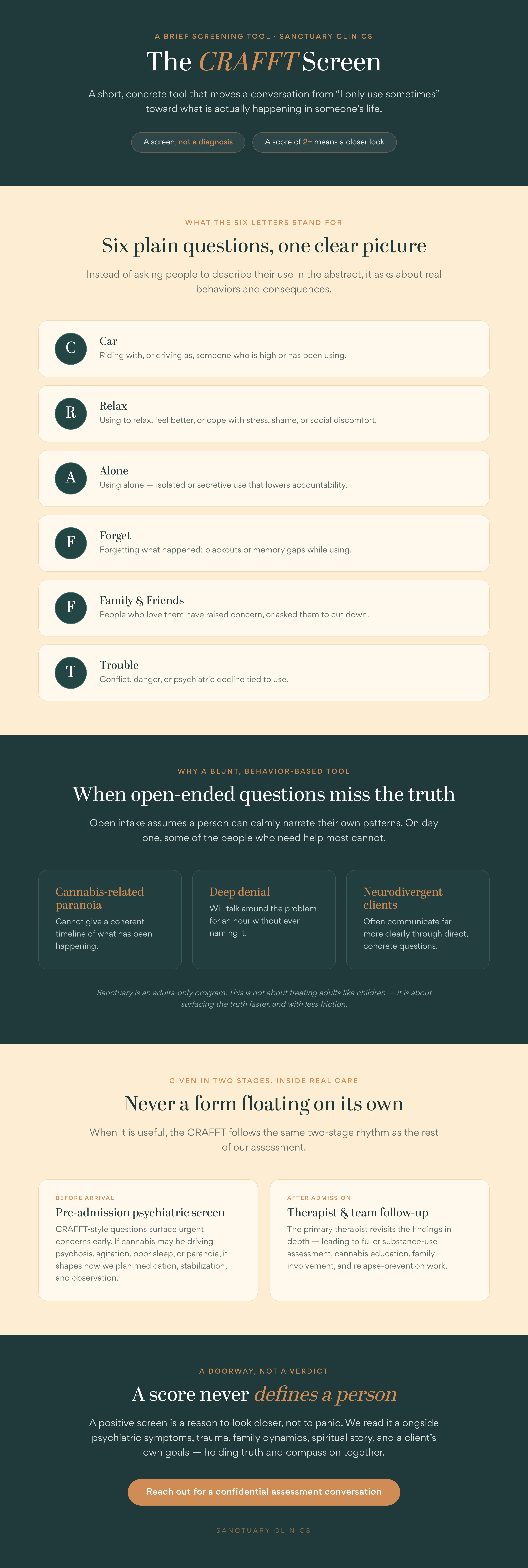
The CRAFFT is a brief screening tool that asks about behaviors and consequences linked to alcohol and drug use. Its name comes from the risk themes built into the questions: Car, Relax, Alone, Forget, Family or Friends, and Trouble. It was first developed for adolescents and young adults, and it is best known for use roughly in the 12 to 21 range, with research supporting use beyond it. A few quick questions, scored simply, where a result of 2 or more is treated as a positive screen that calls for a closer look.
Two things are worth holding onto. First, it is a screen, not a diagnosis. A positive CRAFFT does not prove that someone has a cannabis use disorder or any other formal diagnosis. It flags a pattern worth examining. Second, its strength is its plainness. It does not ask people to describe their relationship with substances in the abstract. It asks whether they use to relax, whether they use alone, whether they forget what happened, whether others have raised concerns, and whether use has led to trouble.
Why do we use a youth-oriented tool with some adults?
Sanctuary Clinics is an adults-only program, so a fair question is why a tool known for younger patients shows up in our intake at all. The answer has nothing to do with treating grown clients as children. It has to do with how people answer questions when they are frightened, defended, minimizing, or psychiatrically unwell.
Open-ended intake assumes a client can step back and narrate their own patterns honestly. Many can. But some of the people who need help most cannot do that on day one. Someone in the grip of cannabis-related paranoia may not be able to give a coherent timeline. Someone deep in denial will talk around the problem for an hour. And some clients, including some who are neurodivergent, simply communicate far more clearly through direct, concrete questions than through broad, open-ended ones. For all of them, the CRAFFT’s blunt, behavior-based questions tend to surface the truth faster and with less friction. That is the whole reason we reach for it.
What are we listening for?
When we use the CRAFFT, we are not only noting whether someone has used a substance. We are listening for the role that substance plays in their emotional life, and for how much danger it is creating. A few patterns matter most:
Using it to relax. Leaning on a substance to manage stress, anxiety, shame, or social discomfort.
Using alone. Isolated or secretive use, which tends to raise risk and lower accountability.
Forgetting while using. Blackouts, memory gaps, or signs that use is eroding awareness and judgment.
Concern from others. Family or friends who already see the problem more clearly than the client does.
Trouble tied to use. Conflict, impulsive decisions, danger, or psychiatric decline connected to substances.
These questions are especially revealing with cannabis, which is easy to wave off as natural or harmless. The CRAFFT structure can show whether cannabis use is actually tangled up with avoidance, slipping judgment, and a life that is quietly coming apart.
Get Help Today.
We are here to help you through every aspect of recovery.
Let us call you to learn more about our treatment options.
We are here to help you through every aspect of recovery. Let us call you to learn more about our treatment options.
Why does this matter in cannabis-induced psychosis?
One of the clearest reasons we use the CRAFFT with certain adult clients is how often cannabis sits underneath a psychiatric crisis. When someone arrives with paranoia, disorganized thinking, or emotional volatility, we need a fast and reliable way to understand what cannabis may be contributing. The CRAFFT is not a psychosis assessment, but it can bring patterns of use and impairment into view that should never be brushed aside.
This matters most early in care, when insight is often lowest. Some clients with cannabis-induced psychosis still insist their use is harmless, or even helpful. Others cannot organize a clear account of anything. In those moments, a short and concrete screen can tell us more than a broad discussion the client is not yet able to hold. From there we move into fuller assessment, psychoeducation, and planning around abstinence, relapse risk, and psychiatric stability.
How do we actually give it?
At Sanctuary, the CRAFFT is never a form floating apart from the rest of treatment. It lives inside a broader, clinically guided intake, and when it is useful, it follows the same two-stage rhythm as the rest of our assessment.
Before arrival. During the pre-admission call with our psychiatric team, CRAFFT-style questions can surface urgent concerns before a client ever reaches campus. If cannabis may be driving psychosis, agitation, poor sleep, or paranoia, we want to know early. It shapes how we think about medication, stabilization, observation, and the supports a client may need the moment they walk in. We would rather be ready than caught off guard.
After admission. Once a client arrives, the primary therapist and treatment team revisit those findings in depth. A brief screen can never replace real history-taking and formulation, but it points the conversation where it needs to go. Positive findings might lead to closer substance-use assessment, focused cannabis education, family involvement, relapse-prevention work, or careful attention to how symptoms shift as a client stabilizes and stays sober.
What does a positive screen mean?
A positive CRAFFT is a reason to look closer, not a reason to panic. The tool’s own guidance is clear that a positive result points toward further assessment and, where appropriate, brief intervention. For us, that can mean a fuller substance-use history, more cannabis psychoeducation, sharper focus on psychiatric safety, collateral information from family, relapse-prevention planning, and tighter coordination between therapy, psychiatry, and recovery staff.
That is exactly why the tool fits our model. It identifies risk quickly, and then a multidisciplinary team interprets what it found in the full context of the person.
How does the CRAFFT fit a Christian whole-person model?
No screening tool defines a person, and a score never will. The CRAFFT is one small instrument that helps us see risk more clearly, and we read its findings alongside psychiatric symptoms, trauma history, family dynamics, developmental functioning, spiritual story, and a client’s own goals.
That matters in a Christian treatment setting, where care has to hold truth and compassion together. People need an honest assessment, and they need dignity and a real path toward restoration. Often a positive screen is not only about a substance. It is about how a substance became a way to quiet fear, loneliness, shame, or inner chaos. Lasting recovery has to reach those deeper places too.
Taking the next step?
The CRAFFT is best understood as a doorway, not a verdict. It is a brief, honest screen built to surface the patterns that deserve a closer look, especially when someone minimizes their use or cannot quite explain what it is doing to them. Used well, with the right clients and inside a real clinical process, it makes our work more precise rather than more simplistic. The goal is always the same: catch risk early, ask better questions, and build a plan that is safer and wiser for the real person in front of us.
That is how we use the CRAFFT at Sanctuary Clinics. Not as a label, but as one practical tool inside whole-person care.