


For thousands of Americans who need residential behavioral health treatment, one obstacle stops them before they ever pick up the phone: they will not leave their dog behind. It is not stubbornness. It is not sentimentality. In many cases, that animal is the single most stabilizing relationship in a person’s life — the one being who has stayed through the addiction, the depression, the divorce, the sleepless nights, the shame. Asking a client to surrender that relationship as the price of admission to treatment is, for a meaningful share of the population, the same as telling them not to come at all.
At Sanctuary, we have decided to answer that challenge with love and understanding. Beginning this program cycle, adults admitted to our Monticello, Florida clinic can bring their dog and stay on the Sanctuary Clinics Honey Lake property — 14 acres of residential land alongside a separate 80-acre private lake — in a shared RV with one other client and their pet. This is pet-friendly residential treatment: a clinical program built around a simple, evidence-based conviction that the human-animal bond is not a comfort item — it is part of the treatment.
Can You Bring Your Dog to Rehab?
Very few residential rehab centers in the United States allow clients to bring their dog. Most require pet surrender at intake — for operational reasons, not clinical ones. This is why families who search for a rehab that allows dogs so often come up empty, and why pet-friendly rehab in Florida is an unusual thing to be able to say honestly.
At Sanctuary Clinics, the answer is yes. Adults entering our residential program at the Monticello, Florida clinic can bring their dog and stay at the Sanctuary Honey Lake property while attending treatment each day. The clinical day runs from 8:00 a.m. to 3:00 p.m. at the clinic. The rest of the day, and the whole overnight, the client is with the dog.

Why Sanctuary Offers Pet-Friendly Residential Treatment
We built a pet-friendly residential treatment option because a barrier we could remove was quietly costing us patients. Adults with substance use disorder describe feeling trapped — wanting to progress in recovery but unable to leave their dog for 30, 60, or 90 days. One man interviewed in a peer-reviewed 2023 study said he hoped to come off methadone but felt he might have to keep buying drugs and detox “his own way” because he could not be separated from his dog (Kerr-Little et al., PMC, 2023). Another had to surrender his dog for rehoming during a depressive episode because no residential support was available. Every clinician in this field has heard some version of that phone call. It ends with the caller saying “I’ll figure something out” — and often, they do not.
That is the barrier the Sanctuary Honey Lake pet-friendly program was designed to remove. It is not a luxury pet retreat. It is not an amenity added to a marketing brochure. It is a working residential treatment continuum with a housing option that keeps the client with the one relationship that has been holding them up.
Get Help Today.
We are here to help you through every aspect of recovery.
Let us call you to learn more about our treatment options.
We are here to help you through every aspect of recovery. Let us call you to learn more about our treatment options.

How Dogs May Support Addiction and Mental Health Recovery
The evidence base for the human-animal bond in behavioral health has moved well beyond anecdote. A 2024 scoping review of 32 studies on the human-canine bond in substance use disorder recovery found that companion animals in recovery are associated with reduced cravings, decreased substance use, improved treatment engagement, and stronger relapse-prevention behaviors (CABI Digital Library, 2024). A 2026 meta-analysis in the Journal of Global Health concluded that animal-assisted therapy produces statistically significant reductions in anxiety, depression, and stress across adult populations (Journal of Global Health, 2026). A systematic review of animal-assisted interventions for trauma populations reported reductions in depression, PTSD symptoms, and anxiety across every study reviewed (O’Haire et al., PMC, 2015).
These findings matter because most adults who enter residential treatment do not arrive with a single diagnosis. They arrive with substance use disorder braided into trauma, with depression braided into complicated grief, with anxiety braided into a history of relationships that did not hold. A trusted animal touches every one of those threads at once.

Stress and the Nervous System
The mechanism is not mysterious. Interaction with a companion animal — being greeted, petted, walked, spoken to — activates the parasympathetic nervous system and the oxytocinergic system while down-regulating the hypothalamic-pituitary-adrenal axis, the body’s central stress-response pathway. Studies have documented lowered blood pressure, reduced cortisol, and increased oxytocin during human-animal interactions, effects that in some studies exceed the physiological benefits of human-human interaction alone (CABI Digital Library, 2024).
For a client entering the first week of residential treatment — a period defined by autonomic dysregulation, poor sleep, cravings, and the return of memories that substances have been suppressing — that physiology matters. A dog leaning against a client’s leg at six in the evening is not sentiment. It is a naturalistic intervention on the same nervous system our medications and our therapies are trying to reach.

Emotional Support, Routine, and Connection
The Substance Abuse and Mental Health Services Administration defines recovery across four dimensions: purpose, community, health, and home. A qualitative study of opioid agonist therapy patients found that companion animals in recovery directly supported all four (Canadian Journal of Addiction, 2023). Patients described their pets as family, as sources of unconditional acceptance, and as confidants who could receive what the patient was not yet ready to say out loud in group.
In a 2018 national recovery survey conducted by the Canadian Centre on Substance Use and Addiction, 88 percent of Canadians in recovery identified their relationship with an animal as an important support, and 44 percent said that relationship had directly helped them continue their recovery from addiction (Canadian Journal of Addiction, 2023).
A separate qualitative study of adults living with substance use disorder found that dog ownership provided fixed routines, a reason to get up in the morning, motivation to leave drug-using environments, a reemerging sense of agency, and reduced marginalization (Kerr-Little et al., PMC, 2023). One participant put it in a single sentence: “He helped me stay clean the whole way.”
What the Sanctuary Honey Lake Pet-Friendly Program Includes
Let us be direct about what this program is and what it is not. It is not a luxury pet retreat. It is a residential treatment option built to remove a specific, common, and clinically significant barrier to care.
The Property
Sanctuary Clinics Honey Lake consists of a 14-acre residential parcel paired with a separate 80-acre private lake in the North Florida countryside, roughly 30 minutes from Tallahassee. The land is quiet, wooded, and safe for dogs. There is water. There is space to walk. There is space to pray and rest in the middle of God’s creation.
Accommodations
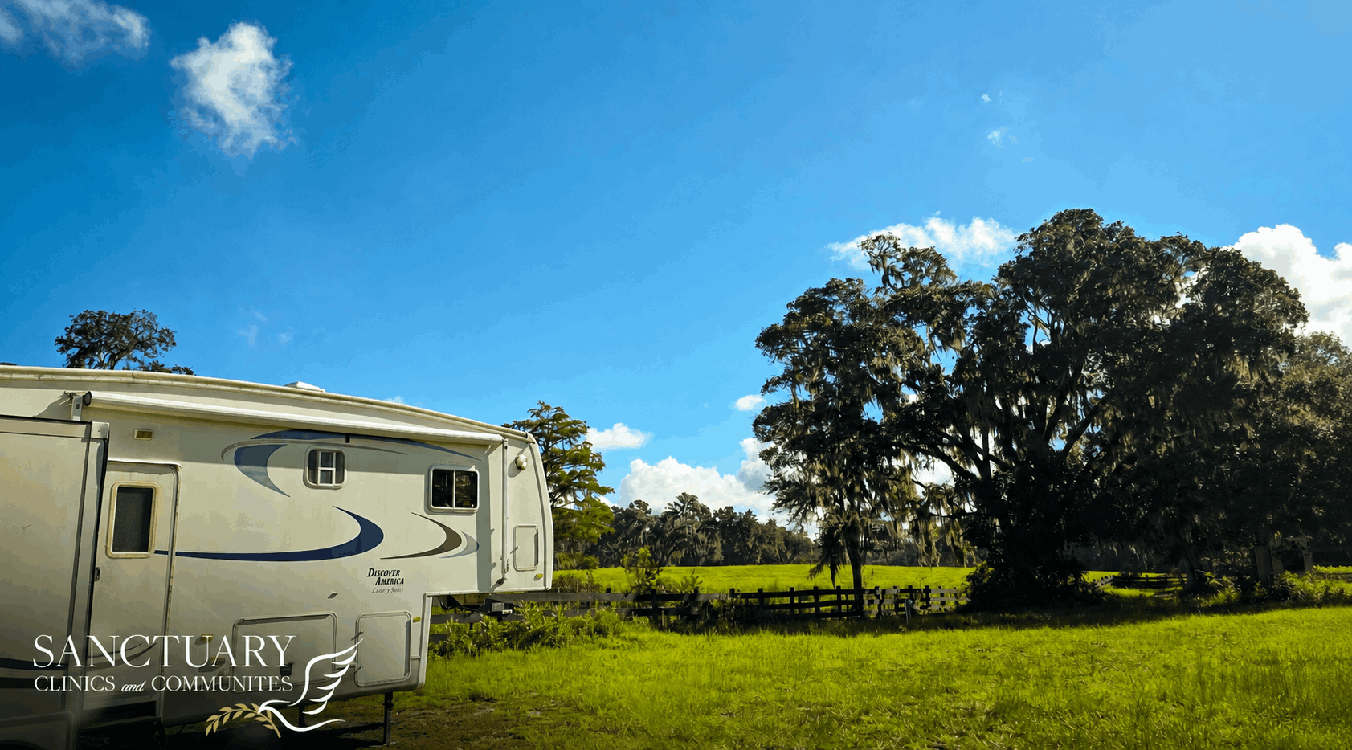
Clients in the pet-friendly track stay in an RV on the property with one other client and their pet. This is intentional. It is affordable, it is honest about what it is, and it removes the barrier of luxury pricing that keeps many families from ever asking about pet-friendly rehab. Clients who need a more clinically intensive residential setting or who cannot share housing are placed in Sanctuary’s standard residential program.
The Clinical Day
Clients travel each morning to the Sanctuary Monticello clinic for their programmed treatment day from 8:00 a.m. to 3:00 p.m. — psychiatric care under our medical team, individual therapy, group therapy, medical monitoring, case management, and the full clinical curriculum. During those hours, the dog remains on the Sanctuary Honey Lake property. Clients return each afternoon.
The Residential Program
This model preserves everything that makes residential-level treatment effective — daily clinical contact, structured programming, medication management, sober housing — while eliminating the single obstacle that keeps a subset of high-need patients from ever engaging.

Get started with our Pet-Friendly Program
Who Is Our Pet-Friendly Rehab Program For?
We are not opening the pet-friendly track to everyone, and we are not opening it to every dog. Clinical fit and animal fit are both screened at admission.
Appropriate candidates include adults entering treatment for addiction, co-occurring anxiety and depression, PTSD and trauma-related conditions, or burnout and moral injury, whose dog is a stable presence in their life and whose separation from that animal would compromise their willingness to remain in treatment. Veterans with service or emotional support animals, first responders, and adults transitioning from acute stabilization into longer-term work at Sanctuary are all strong fits.
The program is not appropriate for clients requiring medical detox or acute psychiatric stabilization, clients whose dogs are aggressive toward people or other animals or have unmanaged medical needs, clients who cannot share housing with one other adult, or clients for whom the demands of pet care would interfere with treatment participation. When a pet is not the right fit for the property, we help the family find safe boarding and preserve the client’s admission — because the point is treatment, not the pet.
Service Dogs vs. Emotional Support Animals vs. Companion Pets
Because this is the question every family asks, it is worth being clear about definitions.
A service dog is individually trained to perform specific tasks for a person with a disability — for example, interrupting a dissociative episode in a veteran with PTSD or alerting to a panic attack. Service dogs have broad legal access rights under the Americans with Disabilities Act.
An emotional support animal is not required to be individually tasktrained. Its therapeutic value comes from its presence, its bond with the owner, and the documented clinical benefits of that bond. Emotional support animals are increasingly recognized in the peer-reviewed literature as a valid psychosocial rehabilitation intervention consistent with the principles of mental health recovery (Springer, 2019). Research has documented measurable reductions in depression, anxiety, and loneliness among adults with serious mental illness who were assigned an emotional support animal and followed over 12 months (Medscape, 2021).
A companion pet is what most families are actually describing when they call us: the family dog, the one on the couch, the one who has been there through the worst year of the client’s life. That relationship produces the same physiological and psychological effects — lower cortisol, elevated oxytocin, greater felt safety, structure, purpose, belonging — regardless of what label the paperwork carries (Journal of Global Health, 2026; CABI Digital Library, 2024).
At Sanctuary, our pet-friendly rehab track is open to service dogs, emotional support animals, and well-behaved companion pets. We evaluate whether this specific bond is clinically meaningful for this specific client and whether the animal is safe and appropriate for the community on the property.

Does Bringing a Dog to Rehab Improve Treatment?
One of the most common questions we hear from referring clinicians is whether allowing pets on-site actually improves treatment outcomes. The literature offers a nuanced answer.
Multiple studies have documented that therapy dogs and canineintegrated treatment programs are associated with greater engagement, higher session attendance, stronger therapeutic alliance, and higher client-rated satisfaction (CABI Digital Library, 2024). Adolescents receiving school-based treatment with a therapy dog attended more sessions than those without one. Residential programs that integrated canine care described the animal component as the single feature that distinguished their outcomes from other centers.
At the same time, one study of a program that permitted patients to bring their companion dogs found that the dog’s presence did not, on its own, extend time in treatment — patients tended to remain for the length of stay authorized by their insurance, regardless. In other words: bringing the dog is not a magic retention lever. It is a barrier-removal tool. It gets the client through the door and keeps the door from closing prematurely.
That is exactly the outcome we are optimizing for. If pet accommodation removes the single reason a client would otherwise never begin treatment — or would leave in week one to get back to their dog — then we have done our job. Everything else that keeps a client engaged happens inside our clinical program: the therapy, the psychiatric care, the group, the case management, the discharge planning, and the aftercare.
What the dog does, in retention terms, is buy us the two things every clinician needs and rarely gets in this population: a client who arrives, and a client who stays long enough for the work to take hold.

Why the Honey Lake Setting Matters
There is a second clinical asset in this program that deserves attention on its own terms: the setting itself.
Research on animal-assisted therapy in natural environments finds that outdoor interaction with animals produces stronger effects on mood, belonging, and wellbeing than the same interaction indoors (Frontiers, 2021). Water has an established effect on parasympathetic tone. Walking a dog along a shoreline is not a leisure activity when a client is in early recovery. It is behavioral activation, exposure to nature, structured physical movement, and social bonding rolled into a single 30-minute intervention that the client will do voluntarily because the dog needs it done.
Every client who has ever told us “I can’t sit still, I can’t do the group work, I can’t be indoors all day” is describing a nervous system that needs exactly this environment. The dog is what makes the client go outside. The Sanctuary Honey Lake property is what makes the outside restorative.
How to Bring Your Dog to Treatment at Sanctuary
Sanctuary’s admissions team screens pet-friendly track applicants alongside our standard residential intake. We assess clinical fit, housing fit, and animal fit in one integrated conversation, and we tell you honestly whether this program is the right level of care for your specific situation. Where it is not, we will help you find what is.
You do not have to leave the dog. Bring the dog. Bring your recovery with you. The lake will be waiting. The clinical team will be waiting. And when the treatment day ends at 3:00 p.m., the one relationship that has never given up on you will be waiting at the door of the RV, tail moving, ready for the walk that is, quite literally, part of the treatment plan.
At Sanctuary, the mission has never been beds filled. The mission has been lives restored — the client’s life, the family’s life, and yes, the life of the dog who has been carrying them this far.
Get started with our Pet-Friendly Program
Pet-Friendly Rehab FAQs
Can you bring your dog to rehab?
A small number of programs across the United States offer pet-friendly rehab. Sanctuary Clinics is one of them. Adults admitted to our Florida program can bring their dog and stay on the Sanctuary Honey Lake property while attending the clinic each day.
Is Sanctuary a pet-friendly rehab in Florida?
Yes. Sanctuary Clinics operates a pet-friendly residential track at its Honey Lake property in North Florida, roughly 30 minutes from Tallahassee. Clients travel to the clinic from 8:00 a.m. to 3:00 p.m. and return to the property in the afternoon.
Does Sanctuary accept service dogs and emotional support animals?
Yes. The pet-friendly track is open to service dogs, emotional support animals, and screened companion pets. We evaluate the human-animal bond and the animal’s safety and fit, not the paperwork category.
What kind of housing is provided?
A shared RV on the Sanctuary Honey Lake property, occupied by two clients and their pets. This is not a luxury program; it is a clinically rigorous residential option at an accessible price point.
Is the pet-friendly track appropriate for medical detox?
No. Clients requiring medical detox or acute psychiatric stabilization complete that level of care first. The Sanctuary Honey Lake pet-friendly track is designed for the residential treatment phase that follows.
What if my dog is aggressive or has medical needs?
Dogs must be non-aggressive toward people and other animals, current on vaccinations, and free of unmanaged medical needs. If a pet is not a fit, we help the family find safe boarding and preserve the client’s admission.

Dr. Thomas Rayner is Chief Medical Officer of Sanctuary Clinics and a psychiatrist with extensive experience in addiction medicine and cooccurring behavioral health treatment. David Hoskins is the founder of Sanctuary Communities and a clinical psychologist who has spent his career building faith-integrated behavioral health treatment programs in the United States and internationally.