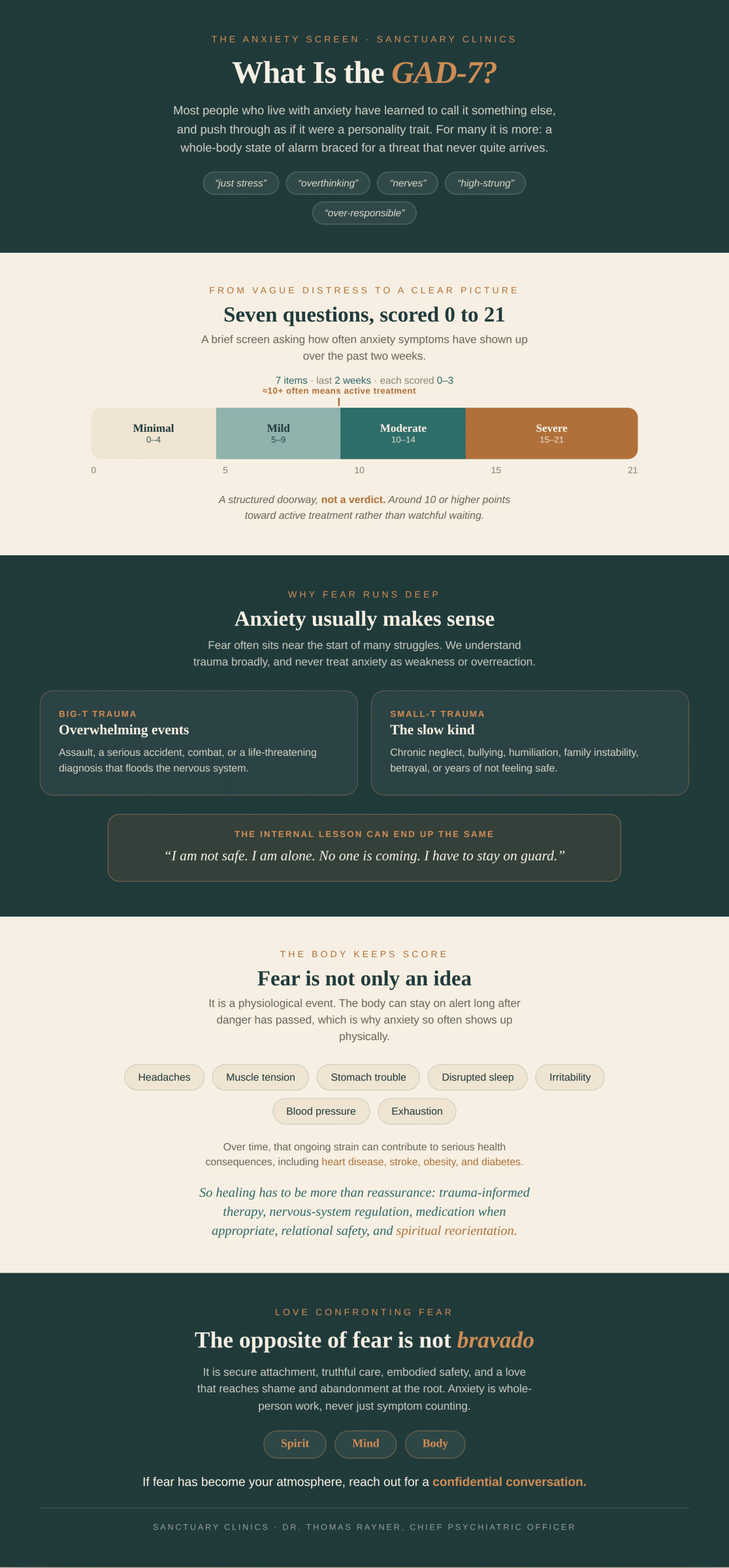

Most people who live with anxiety have learned to call it something else. Stress. Overthinking. Nerves. Being high-strung, or just over-responsible. They push through, because it feels like a personality trait rather than a condition. But for many people it is more than that. It is a whole-body state of alarm that keeps the nervous system braced for a threat that never quite arrives.
At Sanctuary Clinics we take that seriously. One of the ways we begin is with the Generalized Anxiety Disorder Scale, or GAD-7, a brief screen that helps us tell when fear and worry have become significant enough to need real assessment and treatment rather than reassurance alone.
Anxiety is not a small issue. Left unaddressed, it can quietly destabilize relationships, work, concentration, sleep, health, faith, and the simple ability to feel present in your own life. Fear is not only emotional. It is physiological, relational, and spiritual all at once.
What is the GAD-7 designed to do?
The GAD-7 is a brief, seven-item screen that asks about anxiety symptoms over the previous two weeks. Each item is scored from 0 to 3, for a total from 0 to 21. The common severity ranges are 0 to 4 for minimal anxiety, 5 to 9 for mild, 10 to 14 for moderate, and 15 to 21 for severe.
Its value is that it gives structure to something that otherwise feels vague and overwhelming. People often know they are not okay but cannot say how much anxiety is taking from their focus, rest, patience, or daily functioning. The GAD-7 turns that subjective distress into a clearer picture the team can use in broader assessment and planning. In many settings, a score around 10 or higher points toward active treatment rather than watchful waiting. We use it not as a verdict but as a structured doorway into how fear is affecting someone psychologically, spiritually, relationally, and physically.
Why does anxiety matter so much to us?
We treat anxiety as more than symptom management, because fear often sits near the start of many mental health struggles. When trauma, betrayal, chronic stress, neglect, or loss teach a person that they are unsafe and alone, fear can move from a passing emotion into a governing belief about the world. From there it quietly shapes identity and interpretation long before it ever appears as a formal diagnosis. The hidden conclusion tends to sound the same: I am on my own, and something bad is coming.
For us this is also a spiritual matter. We do not treat fear as neutral. Fear intensified by trauma and false belief can work almost like an anti-faith, and our conviction is that love is what confronts it. That does not reduce anxiety to a slogan, and it does not treat it as spiritually irrelevant. It means real healing usually takes both truthful psychological treatment and reconnection to the love of God.
Big-T and small-t trauma – GAD-7
Anxiety is often tied to trauma, and we understand trauma broadly. Some people have lived through what is often called big-T trauma: assault, a serious accident, combat, a life-threatening diagnosis, or other events that overwhelm the nervous system. Others carry small-t trauma: chronic emotional neglect, bullying, humiliation, family instability, betrayal, controlling environments, or years of not feeling safe.
Both matter, because the internal lesson can end up the same: I am not safe, I am alone, no one is coming, I have to stay on guard. Those conclusions reorganize the nervous system and the belief system around fear, and the result is often persistent anxiety, hypervigilance, overthinking, relational insecurity, bodily tension, and trouble resting even when nothing is actually wrong. This is why we never treat anxiety as weakness or overreaction. It usually makes sense in light of what someone has lived through. What once kept a person safe can later become a prison if it is never named, processed, and healed.
Get Help Today.
We are here to help you through every aspect of recovery.
Let us call you to learn more about our treatment options.
We are here to help you through every aspect of recovery. Let us call you to learn more about our treatment options.
How can anxiety progress if left untreated?
Generalized anxiety does not always stay mild. Left untreated, it can deepen and spread. It can coexist with depression, intensify compulsive coping, worsen insomnia, and add physical wear on the body, and it can create a broader climate of fear that makes other symptoms harder to manage.
It is worth being careful here. Anxiety does not automatically become OCD, paranoia, or psychosis, and OCD does not directly cause psychosis. What the literature does show is meaningful overlap, in some people, between anxiety, obsessive symptoms, paranoid thinking, and vulnerability to more severe thought disturbance. That is part of why early treatment matters. The aim is not to catastrophize anxiety, but to take it seriously before fear becomes a ruling system that narrows thinking, shrinks life, and destabilizes the body.
The body keeps score under fear?
Fear is not only an idea. It is a physiological event. Under chronic stress, the body can stay on alert long after any danger has passed, which is why stress so often shows up physically: headaches, muscle tension, stomach trouble, disrupted sleep, irritability, blood-pressure problems, and exhaustion. Over time, that ongoing strain can contribute to serious health consequences, including heart disease, stroke, obesity, and diabetes.
This shapes how we treat anxiety, because a terrified mind usually lives in a dysregulated body. Healing has to be more than reassurance. It often takes trauma-informed therapy, nervous-system regulation, medication evaluation when appropriate, relational safety, spiritual reorientation, and practical skills for lowering the body’s constant alarm.
When medication becomes necessary?
Some anxiety becomes acute enough that medication is not optional but clinically necessary, at least in the short term. Evidence-based guidelines for anxiety and panic note that treatment often combines psychotherapy and medication, with SSRIs and SNRIs as common first-line options and short-term benzodiazepines used in carefully selected acute situations. There are times when the fearful brain is so activated, panicked, or physiologically overwhelmed that it cannot get traction on therapy, daily functioning, or even steadying truths without medical support.
This is part of our whole-person model, not a departure from it. We build individualized plans that can include personalized medication management alongside therapy and complementary approaches. For someone in intense panic or a highly dysregulated state, medication can be an early intervention that lowers the physiological overwhelm enough for deeper work to begin. Our approach is not medication alone and not spirituality alone. It is care for spirit, mind, and body together, including careful medication titration and augmentation when it is clinically appropriate.
How do we use the GAD-7 in treatment planning?
The GAD-7 fits inside a much broader whole-person assessment. It tells us how often fear-based symptoms are showing up and how much they are interfering with daily life, but we read it in context, not in isolation. That context can include trauma history, attachment patterns, psychiatric evaluation, substance use, spiritual history, family-of-origin pain, sleep, medical issues, and current stressors.
So the score helps open larger questions:
- Is this generalized anxiety, trauma-related hypervigilance, panic, obsessive fear, or a mixed picture?
- What experiences taught this person that the world is unsafe, or that they are fundamentally alone?
- How much is fear affecting sleep, focus, work, relationships, and physical health?
- Are there spiritual beliefs or distortions intensifying the fear?
- What level of care and treatment intensity is needed?
Because we work within a Christian and trauma-informed framework, the goal is never just to lower a score. It is to understand what fear is doing in the whole person, then build a plan that restores safety, stability, truth, and hope.
Love confronting fear?
Anxiety is not ultimately defeated by willpower. People need safety, truth, relationship, and love. In our model the opposite of fear is not bravado. It is secure attachment, truthful care, embodied safety, and a love that reaches shame and abandonment at the root.
So anxiety treatment here is not superficial reassurance. It is whole-person work: trauma treatment, psychiatric care when needed, counseling, skills, bodily regulation, truth-telling, spiritual grounding, and slowly relearning how to live without being ruled by fear.
Taking the next step
The GAD-7 matters because fear often hides in plain sight. People call it stress, perfectionism, over-responsibility, burnout, or sensitivity, and underneath those words there may be a nervous system and a belief system organized around threat. The screen helps clarify whether anxiety has become clinically significant and whether someone needs more active help.
That help is never just symptom counting. We treat anxiety as a whole-person issue touching mind, body, relationships, trauma, belief, and faith. With evidence-based care and an explicitly Christian conviction that love confronts fear, we help people move from chronic alarm toward greater stability, truth, and peace.